
The European Union’s Multiannual Financial Framework (MFF) sets out the main points of the EU budget for a period of, usually, 7 years. It puts a ceiling on the EU budget, and explains what it will be spent on and how much each member state has to contribute. For the current period (2021-2027), a total budget was agreed in 2020 of €1,074.3 billion. Negotiations for the period 2028-2024 started in 2025.
More about:
The Multiannual Financial Framework (MFF) is the European Union’s long-term budget. For a period of at least 5 and usually 7 years, it sets the maximum budget, allocates the funds over the EU’s priorities, and states how much the individual member states have to contribute. To a large extent, the MFF determines how much the member states will contribute to and receive from the EU in the years ahead.
The 2021-2027 EU budget is being spent chiefly on cohesion policy to strengthen the economies of poorer regions and on agricultural policy. Both are good for more than €350 billion over the 7-year period. Research and innovation and neighbourhood policy (to increase the prosperity, security and stability of countries neighbouring the EU) are important items, both good for about €100 billion over 7 years. The remainder of the budget is being allocated to migration, defence, healthcare and the Union’s own expenses.
Owing to the great financial significance, negotiation of the MFF is often arduous and protracted. The first proposals are made by the European Commission about 2½ years before the following MFF period begins. The MFF is formally adopted by the Council of Ministers, which must agree unanimously with the proposal. The European Parliament votes by simple majority for or against the proposal but cannot amend it.
Besides the general MFF Regulation, legislative documents are adopted for individual programmes: these documents are specific legislative texts for new and established programmes and funds. The Commission proposes the legislative texts for the programmes. Depending on the programme, a proposal is discussed in the relevant Council formations. The Council for Education Youth, Culture and Sport, for instance, discusses all programmes in its policy field. The decision-making procedure for the programmes follows the ordinary legislative procedure. This means that both the Council and the Parliament decide jointly on the adoption of legislative texts.
When a new MFF is agreed, a decision is usually taken on the EU’s system of own resources. The Own Resources Decision lays down the EU’s funding regulations. Before the Own Resources Decision is taken, the Council must unanimously approve it, the European Parliament must issue a positive advice and each EU member state must approve the decision (i.e. ratify it) in accordance with its own legislative procedure. In the Netherlands, the House of Representatives must approve the Own Resources Decision.
When agreement is reached on the Regulation, the Own Resources Decision and the legislative texts for the programmes, a decision is taken on how much the EU may spend from its annual budget.
More information
- MFF in the Treaty on the Functioning of the European Union, article 312 (PDF)
- How the EU budget is adopted - European Union
- MFF factsheets - European Union
The European Council, consisting of the heads of state and government of the EU member states, agreed to the new Multiannual Financial Framework on 17 December 2020. The MFF is a package of €1,074.3 billion. A day later, on 18 December 2024, the European Council reached agreement with the European Parliament on the economic recovery plan NextGenerationEU, to alleviate the impact of the COVID-19 crisis. The recovery plan amounts to €1,824.3 billion (2018 prices).
When the overall EU budget and its allocation to the EU’s priorities are known at EU level, the funds under shared management, such as the agricultural funds and structural funds, are allocated by means of the national envelope. The national envelope is the maximum amount each member state can claim from the funds. The national envelopes are appended to the respective funds regulations.
The Netherlands is entitled to approximately €8 billion in total for 2021-2027. At more than €5.5 billion, the agricultural funds (EAGF and EAFRD) account for the lion’s share.
Besides the funds under shared management, funds under direct management are allocated directly to projects or institutions funded by the Commission without the intervention of the government. Most of these budgets are spent on research and innovation projects in the Horizon Europe programme. The Horizon 2020 dashboard indicates that Dutch organisations and institutions had received grant funding of €4.23 billion by the end of October 2025 out of the funds available for 2021-2027. This funding is not subject to a national envelope because the money is allocated on the basis of the Commission’s assessment of the grant applicants’ project proposals.
More information
How much does the Netherlands pay into the EU budget and how much does it receive?
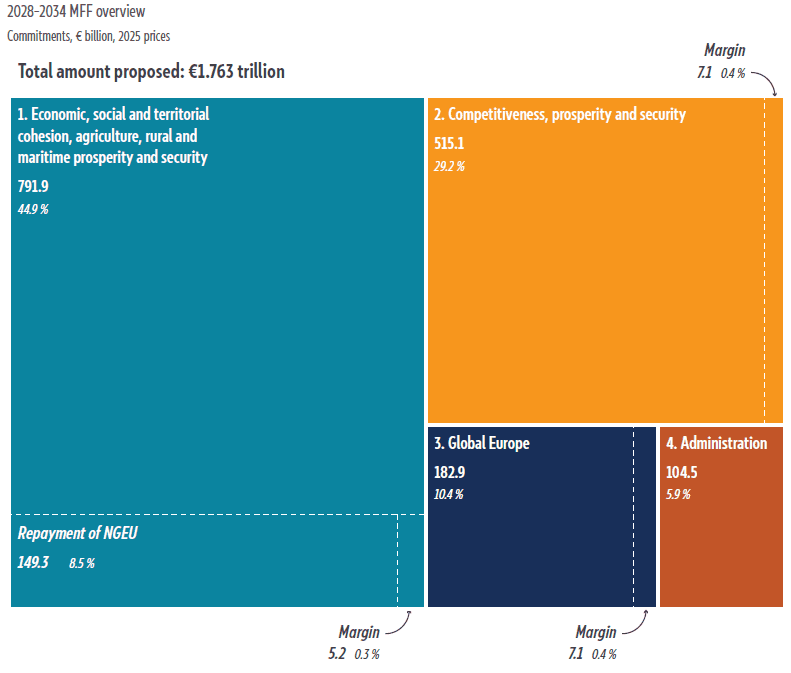
The figure above from the European Parliamentary Research Service (ERPS) shows the allocation of money across the 4 budget chapters in the proposal.
The European Commission presented its proposal for the next MFF on 16 July 2025. Parallel to this, it presented a proposal for a new own resources decision to establish how the EU budget is financed. The Commission’s proposals mark the start of negotiations for the new multiannual financial framework for 2028-2034, which are expected to continue until the end of 2027. The European Council will first consider the negotiation of the MFF on 18-19 December 2025.
Expenditure
The proposed budget for the 7-year period amounts to nearly €1,800 billion. As a percentage of EU GDP, it is slightly higher than in the previous MFF, 1.26% versus 1.13%. Part of the proposed 1.26% (0.11%) is earmarked for the repayment of RRF loans and interest payments.
The Commission has proposed reforming the MFF by reducing the number of budget chapters to 4, merging funds and applying performance-based budgeting. The Commission wants the MFF to focus more on themes such as competitiveness, security and defence, and asylum and migration. To improve the response to unforeseen circumstances, the proposal also provides for greater budget flexibility.
The Commission has proposed the following 4 pillars:
- Pillar 1: National and regional partnership plans (45% of resources, €791.9 billion). This pillar is made up of the current structural and investment funds, agricultural funds and migration funds;
- Pillar 2: Competitiveness, prosperity and security (30% of resources, €515.1 billion). Besides funding for competitiveness, this pillar includes security and defence;
- Pillar 3: Global Europe (11%, €182.9 billion). This concerns the Union’s external policy and the external aspects of migration.
- Pillar 4: Administration (6%, €104.4 billion).
Repayment of the RFF loans and interest payments will cost a further €149.3 billion (8.5%).
The table below from the European Parliamentary Research Service (ERPS) shows the allocation of money across the 4 budget chapters in the proposal.
|
Pillar |
title |
Commitments in € billion |
Percentage |
|
1 |
Economic, social and territorial cohesion, agriculture, rural maritime prosperity and security |
791,9 |
44,9 |
|
1 |
Repayment of NGEU |
149,3 |
8,5 |
|
2 |
Competetiveness, prosperity and secrurity |
515,1 |
29,2 |
|
3 |
Global Europe |
182.9 |
10,4 |
|
4 |
Administration |
104,4 |
5,9 |
|
Marge |
19,4 |
1,1 | |
|
Total |
1.763 |
100 |
These proposals would lead to a shift in priorities. In the current period, 70% of resources are committed for the funds in pillar1, but only abut 45% in the next period. More money would be committed to innovation and security (pillar 2). The commitment would rise from 17% of total resources to 30% (source: government assessment of 12 September 2025 of the new MFF).
Pillar 1 broadly follows the performance-based funding structure of the Recovery and Resilience Facility. Member states must prepare investment and reform plans to address the various policy priorities in pillar 1 and a significant proportion of the country-specific recommendations made in the European Semester. Payments depend on the achievement of milestones and targets. The Commission checks achievement after receiving payment requests from the member states. If not all milestones or target have been met, payments to the member states can be reduced pro rata. Only the member states themselves are affected by payment reductions. They must still make payments to beneficiaries (e.g. subnational authorities, businesses and citizens). This budgetary incentive induces the member states to make reforms and provides assurances to beneficiaries. The Commission has also published an overarching proposal for a regulation to establish a performance framework that would apply to the MFF as a whole.
Revenue
On the revenue side, the Commission has proposed 5 new own resources. They are based on:
- the EU Emissions Trading System, ETS1),
- the Carbon Border Adjustment Mechanism (CBAM),
- non-collected e-waste,
- a tobacco excise duty own resource (TEDOR),
- a Corporate Own Resource for Europe (CORE).
These new own resources are in addition to the existing own resources of customs duties, the VAT-based resource, the non-recycled plastic waste resource and the GNI-based resource. The GNI-based resource is by far the largest own resource and serves to balance the EU budget. At present (2025), the Netherlands contributes 6.4% to the EU GNI-based resource. Since the 2002 own resources decision, however, it has paid less than that percentage because it, like Germany, Sweden, Austria and Denmark, has enjoyed a rebate on the GNI contribution in part-compensation for its position as a net contributor. The Commission wants to eradicate these rebates in the next MFF, which, according to the government, will cost the Netherlands on average approximately €2 billion per annum in additional contributions as from 2028.
At present member states can keep 25% of the customs duties they collect to defray the cost of levying and collecting the duties. The Commission wants to reduce this collection refund from 25% to 10%, which the government estimates will cost the Netherland €0.5 billion per annum.
Government assessment
The government sent its assessment of the Commission’s proposals to the House on 12 September 2025. It welcomes the proposed modernisation of the MFF, with the Commission focusing more on strategic priorities and mobilising more of the EU budget for them. The government agrees with the proposal that agreed conditions or results must be met before payments are made from EU funds. However, it has questions about, for instance, the administrative burdens imposed by this system and how the proposal will play out in practice. The resultant increase in EU contributions is incompatible with the budgetary frameworks agreed in the framework coalition agreement. The government will therefore seek a reduction in the proposed MFF. The government also thinks the Netherlands’ contribution is too high relative to other member states’ contributions. It believes a reduction in the GNI-based contribution will be necessary to improve the relative distribution. The government will also seek to retain the 25% collection refund at its present level. With regard to the proposed new own resources, the government would like to know what the distributional impact will be. Finally, the government is not in favour of assuming common debt for new European instruments and does not support the proposals to take on loans for a crisis instrument and to increase the budget for pillar 1.
Thoughts about EU performance-based funding
By letter of 10 September 2025, the Netherlands Court of Audit informed the House of Representatives of its first impressions of a new EU method to fund projects. The Union will pay out funds only when predefined results have been achieved.
More information
- Information from the European Commission on the new MFF
- Kamerbrief Nederlandse inzet onderhandelingen MFK 2028 - Letter (in Dutch) from the Minister of Foreign Affairs on the Netherlands’ proposals for the MFF 2028 negotiations.
- Multiannual Financial Framework 2028-2034 – Communication from the Commission on the 2028-2034 MFF
- Letter by Netherlands Court of Audit on audit of performance-based EU funding
- Government assessment of 12 September 2025 of the new MFF (in Dutch)
- Final report of the House of Representatives’ MFF rapporteurs of 29 September 2025 (in Dutch)
Last updated in December 2025, situation in October 2025.