
Summary
The shortage of housing in the Netherlands is a major social problem. The government has set itself a goal of adding 100,000 properties a year to the country’s housing stock, a goal for which the Minister of Housing and Spatial Planning is responsible. From 2020 to 2024, the primary financial instrument available in this respect was the House Building Incentive Scheme. This provides central government funding to help municipalities achieve the specified targets, with a total of €2.25 billion being set aside for the scheme during this period.
In Tackling the Housing Shortage, a report we published in 2022, we concluded that the minister had not provided sufficient evidence to show that the scheme was achieving its goals. At that time, the minister could not yet determine whether the scheme had resulted in more affordable housing being built more quickly than otherwise. However, we expressed serious doubts as to whether it would achieve the intended results. As we said at the time, ‘If it is decided to continue [the scheme], the Minister of Housing and Spatial Planning will have to fundamentally redesign it to ensure that public money is spent efficiently and effectively.’
While no concrete results were available at the time of our 2022 audit, the results achieved by the incentive scheme are now visible. Grants awarded under the scheme during the above period were made available in six tranches. By now, projects awarded a grant in the first three tranches will have started. By comparing the results of these projects and those started during the same period without a government grant, we can form a view on what the scheme has actually achieved. This confirms the serious doubts that we previously expressed regarding the scheme’s effectiveness.
Our main conclusions are:
- The House Building Incentive Scheme has not resulted in houses being built faster. Indeed, 75% of the projects receiving a grant in the first three tranches experienced delays of, in some cases, up to two years. In most cases, the problems causing the delays were not resolved by grants awarded to municipalities under the incentive scheme. Similarly, we found no evidence that the pressure of possibly having to repay grants had any noticeable impact on results.
- Having completed this follow-up audit, we continue to have serious doubts as to whether the scheme is resulting in more homes being built. On the one hand, all the projects receiving a grant under the scheme have gone ahead, whereas three of the eighteen projects not receiving a grant have not started. This indicates that the scheme has produced some benefits, albeit limited. On the other hand, projects may have been awarded grants at the expense of other projects, which makes it difficult to determine their net effect. The minister has not come up with a solution for mitigating the possible risk of crowding-out (see the third recommendation in our previous report).
- In some cases, we can conclude that the incentive scheme has resulted in more affordable new homes being built. Of the housing projects not receiving a grant, 33% experienced a reduction of 10% points or more in the share of affordable homes, whereas this applied in the case of only one project awarded a grant. However, few if any specific measures are yet in place to ensure affordability in the longer term (see the fourth recommendation in our previous report).
Project results, based on the incentive scheme’s 3 goals
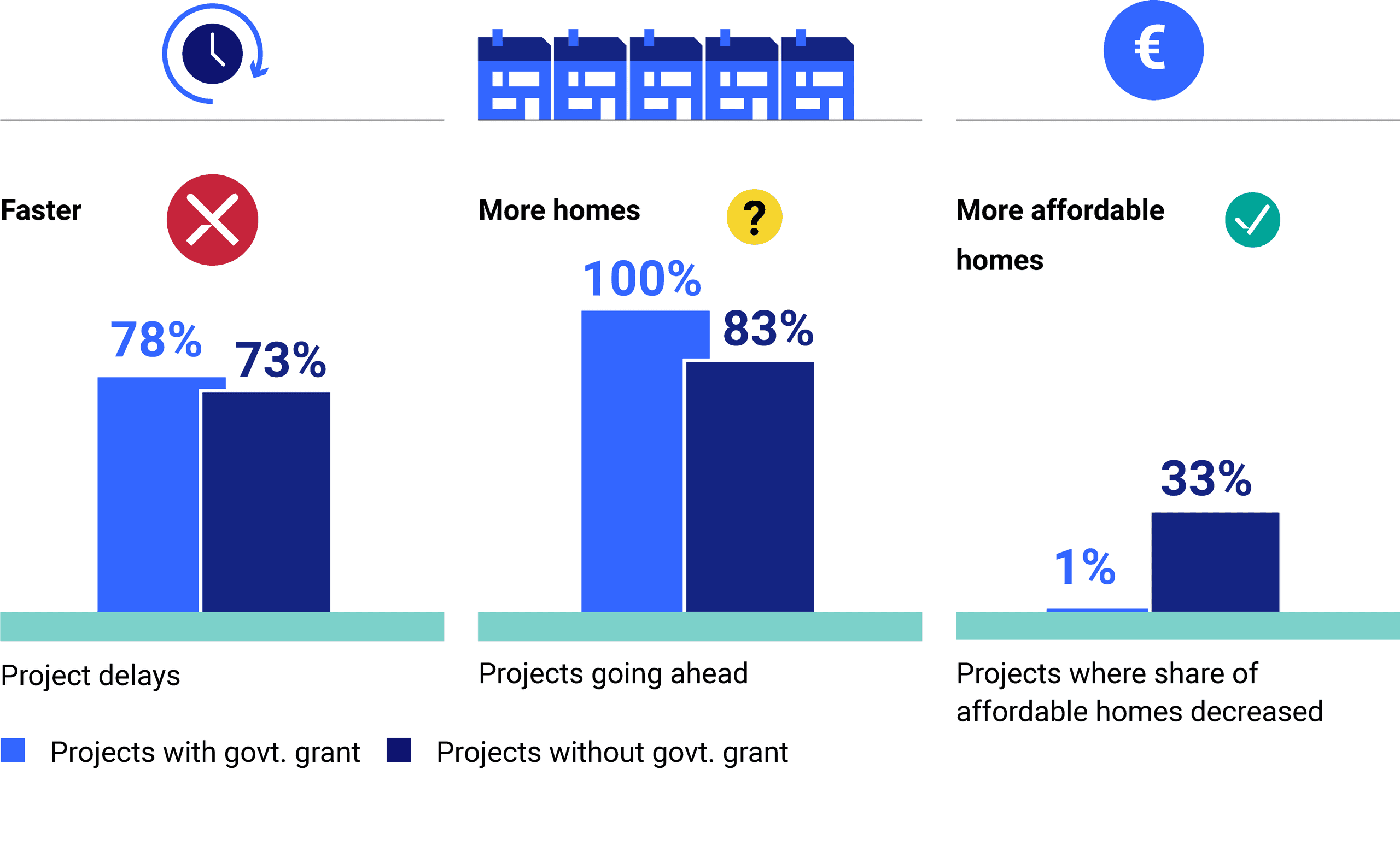
This diagram shows how grants awarded under the House Building Incentive Scheme are not resulting in homes being built more quickly. However, the scheme is boosting the number of affordable homes. Serious doubts exist as to whether the scheme is resulting in higher numbers of homes being built.
- A total of 78% of the housing projects receiving a grant under the scheme experienced delays. In the case of projects not receiving a grant, 73% experienced delays.
- All the housing projects receiving a grant under the scheme went ahead. Of the projects not receiving a grant, 83% went ahead.
- Of the housing projects receiving a grant under the scheme, 1% experienced a reduction of 10 percentage points or more in the share of affordable homes. Of the housing projects not receiving a grant under the scheme, 33% experienced a reduction of 10 percentage points or more.
| Project with govt. grant | Projects without govt. grant | |
|---|---|---|
| Project delays | 78% | 73% |
| Projects going ahead | 100% | 83% |
| Projects where share of affordable homes fell by more than 10% points | 1% | 33% |
Most of the changes made by the Minister of Housing and Spatial Planning in recent years were intended to increase the number of projects eligible for the scheme. In this respect, recommendations made in our previous audit were implemented to only a limited degree. We had recommended, for example, making more targeted use of public funds by focusing the scheme on regions with the greatest housing shortages, whereas the minister did the opposite by further extending the range of eligible projects. Following, however, an interdepartmental policy audit in 2024 involving a wider-ranging analysis of the housing market, the minister reconsidered the incentive scheme and proposed that it should once again target complex projects.
While the minister can outline the main direction with regard to spatial planning, the extent of her influence is limited, even though projects are subject to qualifying conditions and are actively monitored. Much of the responsibility for housebuilding is vested in municipalities. On top of that, area development and housebuilding are complex processes involving a multitude of parties, and where money (or more money) is not always the solution. In that respect, the goals of the House Building Incentive Scheme can be regarded as overambitious.
More often increase than decrease in number of homes built in projects, regardless of government grant
Based on our conclusions, we recommend that:
- Housebuilding policy should be more evidence-based and take account of all the potential bottlenecks and how they interact. In other words, if production of new houses is to increase and accelerate, additional policy will be needed alongside financial instruments such as the House Building Incentive Scheme. This could include shortening the procedures and designating more sites available for building.
- The House Building Incentive Scheme should be reconsidered or fundamentally redesigned. We see two possible options in the latter respect: a broad-ranging incentive scheme focusing solely on affordability or an incentive scheme targeting a limited selection of complex housebuilding projects designated for a specific purpose.
Our previous audit’s recommendation regarding measures to ensure longer-term affordability remains relevant.