
Auditors from the Netherlands Court of Audit are using the Accountability Desk to engage with the public. They have just ended their first tour of the country. From Amersfoort to Zevenaar and from Hengelo to The Hague, what have they learnt? And what is the Accountability Desk’s added value?

The Accountability Desk in Zeewolde
“What do you prefer, the navy or the army?”
“Have you got a moment, can I ask you a question?”
“You look like someone who runs their own business!”
Which of these 3 sentences is not a good opening line if you want to invite unsuspecting passers-by or event visitors to start talking at the Accountability Desk? Project leader Ruiter Janssen and Security and Foreign auditor Paulien Hesselink have learnt not to ask the second question. People can always say “No” or “Sorry, I don’t have the time” and walk on by.
“Look at it this way,” says Paulien. “The Accountability Desk is a definite eye-catcher that people find intriguing. It was designed so that people would stop and stare. That’s the easy part. You then have to get over your nerves and ask complete strangers if they want to sit down and join you.”
To get over the awkwardness, the 30 auditors holding the Accountability Desk talks have been trained in how to engage with the public. And they learnt an important lesson: never begin with a question that people can answer with a “Yes” or a “No”. Paulien was a good learner. “When I talked about security in Zeewolde, I asked ‘What do you prefer, the navy or the army?’. People really had to think about their answer. It was a great way to start a conversation.”
Whether people want to join in the conversation also depends on the topic. “Getting people to talk about citizen participation was difficult in Venlo,” says Ruiter. “But in Zeewolde people would start talking before we’d properly set up the desk. And in Amersfoort people were queuing up to talk about whether paying taxes made for a better society.”
From opening line to newspaper article
The talks at the Accountability Desk follow a fixed method, with propositions and arguments written down on cards. The auditors have to listen and ask the right questions, they shouldn’t get tied up in a discussion. “The method is just a tool,” says Paulien. “It’s important that people know you are listening to them.” But even she was sometimes tempted to enter into a discussion.
In Zeewolde the proposition was, “The security of the Netherlands comes first, doesn’t it?” Not by accident, Zeewolde is in the running to be home to a new Ministry of Defence barracks. “I was talking to a military man who was so in favour of the barracks that I wanted to record his argument and play it to all the barracks’ opponents. That was really interesting.”
The talks were certainly surprising. “In Zeewolde everyone immediately started talking about the barracks,” Paulien reflects. “But in The Hague people discussing security wanted to talk about climate change and integration.”
Some talks led to something special. One of the visitors in Zeewolde, a well-informed former employee of the Council of State, went on to write an article for the local newspaper. At the catering fair in the Rotterdam Ahoy halls, the auditors had a chance to sound out caterers, something that surveys of this target group had failed to do. “The Accountability Desk was a real ice-breaker,” says Ruiter.
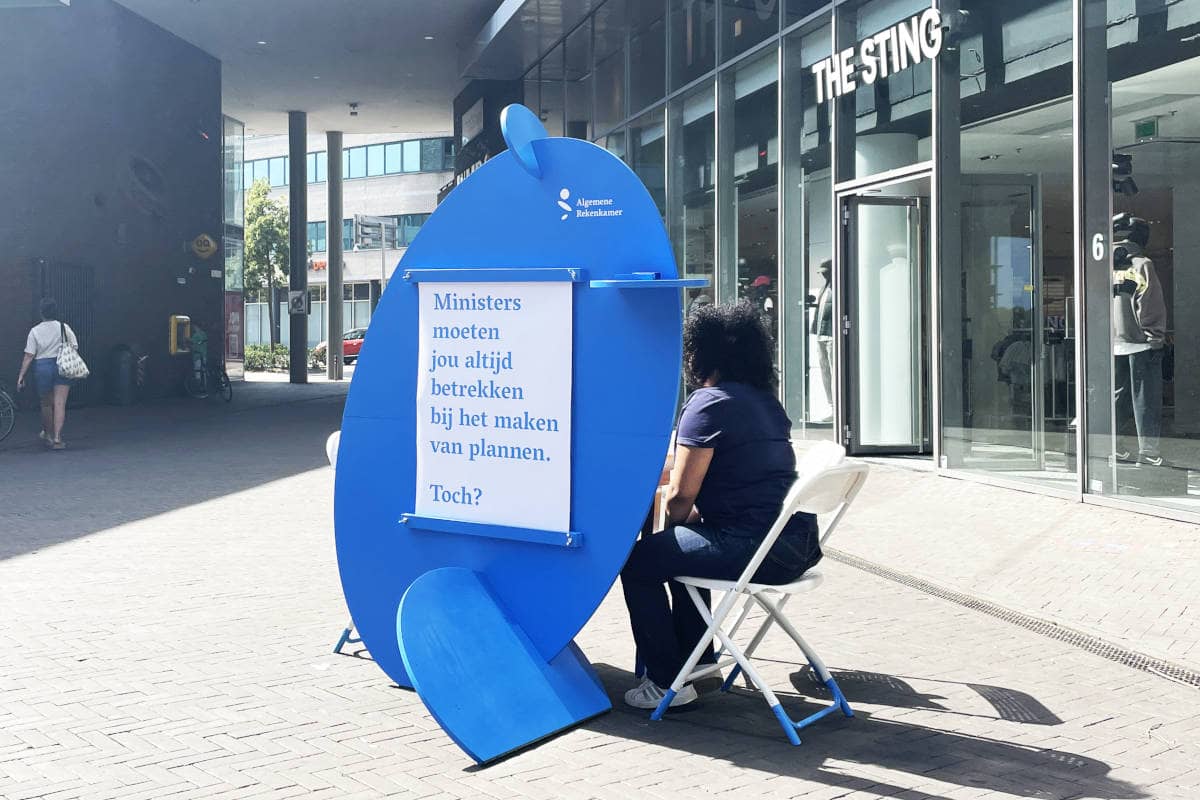
The Accountability Desk in Venlo
The strength of the Accountability Desk
Paulien, Ruiter and their colleagues are enthusiastic about the Accountability Desk. What do they think its strength is?
“You find out that your assumptions are often wrong,” admits Paulien. “Opinions are broader than we think. Take the Ministry of Defence and the new NATO standard, it won’t be the last time new barracks are built. And local, provincial and national authorities can learn a lot from this method.”
According to Ruiter the strength lies in the opportunities to gain new ideas, outside your own bubble. “That really is an enrichment. It’s not surprising that many auditors end a talk with a twinkle in their eyes and say, “Wow, that was interesting’.”
Making a difference
The Accountability Desk adds another perspective to risk analyses, a new approach, as it were, to identify audit topics. “Our ambition this year is to audit a topic that was raised at the Accountability Desk,” says Ruiter. And the Accountability Desk itself can also be improved, for instance by refining the method.
And what benefit do the public have apart from a good talk with an auditor about a socially relevant topic. Paulien sees the wider context, “The mission of Supreme Audit Institutions is to make a difference in the lives of citizens.
“We sometimes forget that. We often ask how much money is available for a particular topic and then talk with the ministries. Perhaps an audit of children who stop making progress at school would be just as interesting, if not more so. The Accountability Desk helps open our eyes. But its biggest advantage is that it gives people a chance to influence our audit programme. That’s a valuable contribution to democracy!”