
The Netherlands contributed less to the European Union in 2024 than in previous years. Its contribution for the year came to €7.5 billion, down from more than €9.2 billion a year earlier. Revenues on the other hand increased by some €266 million to €3.15 billion. The figures are presented in the Netherlands Court of Audit’s most recent update of its EU web page.
One cause of the lower payment in 2024 was that the underspend on the EU budget reduced the Dutch contribution by €2.4 billion compared to an earlier estimate.
In 2023, the Netherlands was the largest net contributor after Germany (expressed as a percentage of gross national income, based on the European Commission’s definition), but in 2024 France and Sweden also made higher net contributions than the Netherlands.
Net payment position of the Netherlands in 2014-2024
% GNI
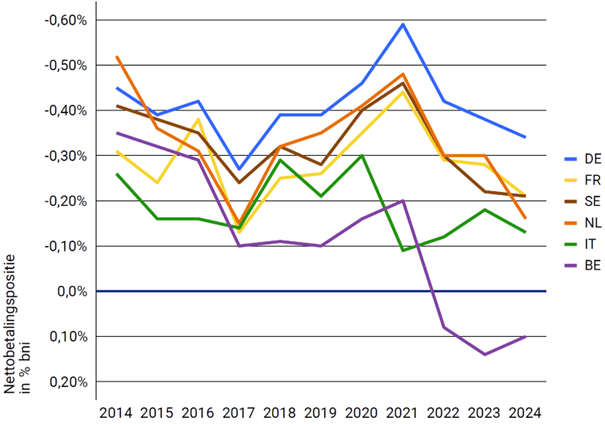
Net position of 6 net contributors as a percentage of GNI under the accounting definition (2014-2024)
Jaar BE DE FR IT NL SE 2014 -0,35 -0,45 -0,31 -0,26 -0,52 -0,41 2015 -0,32 -0,39 -0,24 -0,16 -0,36 -0,38 2016 -0,29 -0,42 -0,38 -0,16 -0,31 -0,35 2017 -0,10 -0,27 -0,13 -0,14 -0,15 -0,24 2018 -0,11 -0,39 -0,25 -0,29 -0,32 -0,32 2019 -0,10 -0,39 -0,26 -0,21 -0,35 -0,28 2020 -0,16 -0,46 -0,35 -0,30 -0,41 -0,40 2021 -0,20 -0,59 -0,44 -0,09 -0,48 -0,46 2022 0,08 -0,42 -0,29 -0,12 -0,30 -0,30 2023 0,14 -0,38 -0,28 -0,18 -0,30 -0,22 2024 0,10 -0,34 -0,21 -0,13 -0,16 -0,21
Only direct cash flows included
The figures do not include the Netherlands’ receipts from (and payments to) the Recovery and Resilience Facility. The Netherlands received its first payment from the facility in 2024. Loan repayments will not start until 2028. In addition, the net payment position relates to direct financial flows only. It provides no information on other financial, economic and social costs and benefits that a country has from the EU.
The Netherlands Court of Audit reports twice a year on the EU funds the country receives, its payments to the EU and its implementation of European legislation.
External audit of the European Investment Bank (EIB)
The new update also refers to the concerns expressed in the Statement on the external public audit of the European Investment Bank published by the heads of EU supreme audit institutions on 30 September 2025. The European Court of Auditors can audit only a quarter of the EIB’s operations. No arrangements are in place for the independent, external audit of the other three-quarters. The heads of the supreme audit institutions therefore call for this ‘gap’ to be closed by involving national audit offices in the EIB’s audit.
Multiannual financial framework
Finally, the update considers the state of play of the EU's new multiannual budget. Negotiations have commenced and the European Commission published its proposals on 17 July 2025. The Netherlands Court of Audit is keeping track of developments on its EU web pages.