
To transition from fossil fuel to sustainable forms of energy, the Minister of Climate Policy and Green Growth (KGG) is supporting the production, transport and use of hydrogen. In 2023, the minister appointed the state-owned enterprise Gasunie/HNS to develop and operate a hydrogen network. Gasunie/HNS is a subsidiary of Gasunie, a 100% shareholding of the Minister of Finance.
Grants have been mobilised to incentivise production of green hydrogen and its uptake by customers. In 2023, the minister decided to award Gasunie/HNS a further grant of up to €750 million to overcome the chicken and egg problem of investing in a hydrogen network while hydrogen customers were reluctant to commit themselves before the network was built. The ambition was to develop a national network to transport sustainable hydrogen to 5 industrial clusters. The network would be approximately 1,200 km long, with completion planned for 2030.
The grant was intended to compensate Gasunie/Hynetwork Services (HNS) for startup losses: low demand for transport capacity during the initial phase would prevent Gasunie/HNS from earning back its investment. On completion, the network should break even after 2033. The Netherlands Court of Audit has found that this grant will probably be inadequate to develop the entire network.
The estimated cost of the network has risen sharply, partly because of the war in Ukraine. Gasunie/HNS’s latest estimate puts necessary loss compensation at €2.5 billion, €1.8 billion more than the maximum available grant (€0.75 billion). It is uncertain whether current grant funding is enough to develop the entire network. Only 1 section of the network is currently being built, in Rotterdam/Rijnmond. Feasibility studies will have to be carried out for the other 14 sections. The chicken and egg problem still exists at network section level, and is perhaps even bigger.
The hydrogen netwerk enables national and international transport and storage
The hydrogen network in the Netherlands connects the 5 industrial clusters Noord, IJmond, Rijnmond, Zeeland en Limburg with the storage facility and the import terminals. The map also shows how electrolysers, wind farms and import and export are interwoven into the network.
The government has adequately argued the case for sustainable hydrogen as a means to achieve a climate-neutral energy system by 2050. The hydrogen will be used chiefly in energy-intensive industries such as the refinery, chemical, steel and fertiliser industries, which currently rely on fossil fuels and unsustainable hydrogen.
Grant inadequate, risk to the public purse
Gasunie/HNS stated in its 2023 grant application that it would need €857 million in loss compensation. The €750 million grant provided by the government was therefore already inadequate in 2023. In 2025, Gasunie/HNS said the network’s estimated cost had risen to €3.8 billion and loss compensation to €2.5 billion, more than 3 times the available grant.
If the Minister of KGG wants to realise a complete network, a solution needs to be found for the expected losses. The options are a higher grant, a higher transport fee and/or a new allocation of costs to current and future users (intertemporal cost allocation). It is also uncertain how the bill will be footed by the Minister of KGG, the Minister of Finance, Gasunie/HNS and network customers.
Given the amounts involved, there is a risk that the grant will miss its goal. There is also a risk to the public purse as all stakeholders want to avoid a sharp increase in transport fees.
Estimated startup losses in 2025 are 3 x higher than available grant funding
In millions of euro's
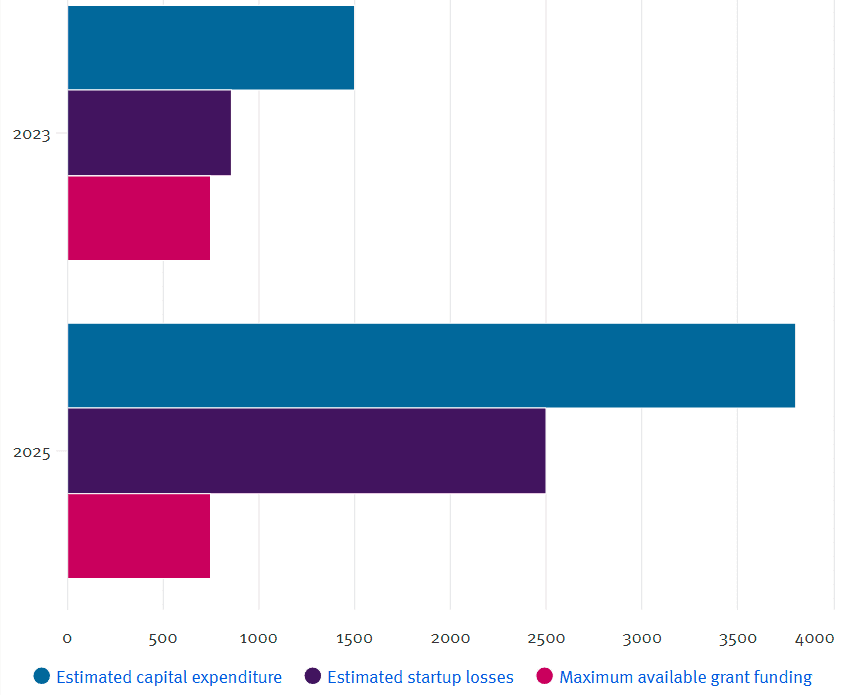
Data in a table
| | Estimated capital expenditure | Estimated startup losses | Maximum available grant funding |
|---|---|---|---|
| 2023 | 1500 | 857 | 750 |
| 2025 | 3800 | 2500 | 750 |
Higher losses due to higher costs and lower than expected supply and demand
The increase in Gasunie/HNS’s estimated losses has several causes:
- Higher construction costs. The cost of building the hydrogen network has risen sharply in recent years. The most recent estimate to develop the entire network is €3.8 billion, versus an original figure of €1.5 billion in 2021.
- Supply of sustainable hydrogen is far lower than anticipated. Gasunie/HNS’s business case was based on the transport of 4 GW as from 2030. This is no longer realistic. Only 1 electrolyser is currently being built in the Netherlands, with a capacity of 0.2 GW.
- Demand for hydrogen is also lower than expected.
Construction of complete network uncertain due to low demand
The Minister of Finance and Gasunie/HNS have agreed that there must be sufficient demand before work begins on each of the 15 network sections. Before an investment decision can be taken, energy-intensive industries must guarantee that they will use hydrogen to become more sustainable and sign a transport contract with Gasunie/HNS. The contracts Gasunie/HNS must sign in each of the industrial clusters must cover 25% of its revenues (10% for connections between sections, with the exception of the Rhine Delta Corridor). Given the low demand for hydrogen, there is a realistic risk that some sections will not be built and it is uncertain whether the entire network will be completed.
“Uncertainty is part of the energy transition,” says Barbara Joziasse, Board member of the Court of Audit. “Projects at this scale have never been attempted before. At least €11 billion is need for hydrogen. Every link in the production, transport and use chain has to work with each other to get such a huge project off the ground, often in changing circumstances.”
But she also points out, “Precisely because so much public money is involved, the government must respond alertly if it is to operate more effectively and efficiently. Our audit looked at the hydrogen network but it also provides lessons for other major projects, such as CCS and nuclear energy.”